Getting To Good Laboratory Practice

Good Laboratory Practice (GLP) is a quality system for planning, performing, monitoring, recording, reporting and retaining nonclinical animal studies. Sticking to GLP ensures the validity of your nonclinical safety data – that it has integrity and reliability. 

Learn about:

GLP history
Purpose and principles
When its required
Sticking to the guidelines
Drug development and GLP
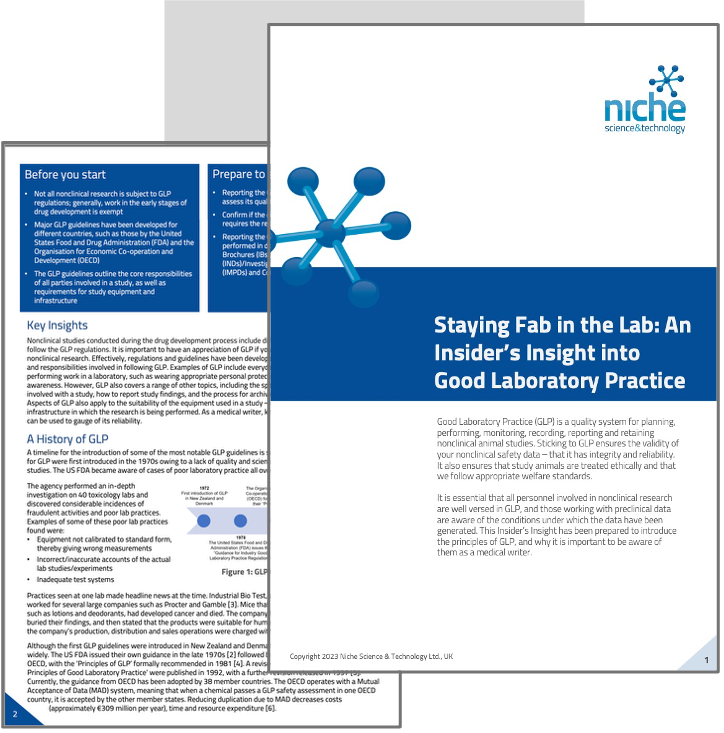
First page of a white paper titled Staying Fab in the Lab: An Insider's Insight into Good Laboratory Practice with blue and white design, showing introduction text and timeline diagram.
Join the other 20,000+ pharma colleagues who have downloaded our Insider’s Insights.

Get your Insider's Insight

* indicates required

Frequently Asked Questions about the Insider’s Insight: Good Laboratory Practice

To help you get the most out of our resource library, we have compiled answers to the most common questions regarding the development, application, and distribution of our specialist guides.

At Niche Science & Technology, we believe that sharing expertise is the first step toward industry-wide excellence.
GLP is a quality system for planning, conducting, monitoring, recording, reporting, and archiving nonclinical laboratory studies. It ensures that safety data are reliable, reproducible, and ethically generated.
GLP is generally required during the nonclinical stages of drug development, especially for studies needed before an IND/IMPD submission—such as repeated‑dose toxicity, genotoxicity, and safety pharmacology studies. Early exploratory studies may not require GLP compliance.
GLP does not dictate the scientific methods used but provides the framework for how studies must be conducted. Study reports should clearly state GLP status, and audits from an independent Quality Assurance Unit (QAU) help verify compliance.
GLP status should be included in documents that summarise nonclinical studies, such as Investigator’s Brochures (IBs), INDs/IMPDs, and Common Technical Documents (CTDs).
Frequent issues that can compromise data integrity and GLP adherence include:
- Poor equipment calibration
- Inadequate documentation
- Improper use of PPE
- Misinterpretation or misrecording of data
- Lack of communication between researchers
- Not performing blinded assessments when required

Get our latest news and publications

Sign up to our news letter

© 2025 Niche.org.uk     All rights reserved

HomePrivacy policy Corporate Social Responsibility
chevron-down